


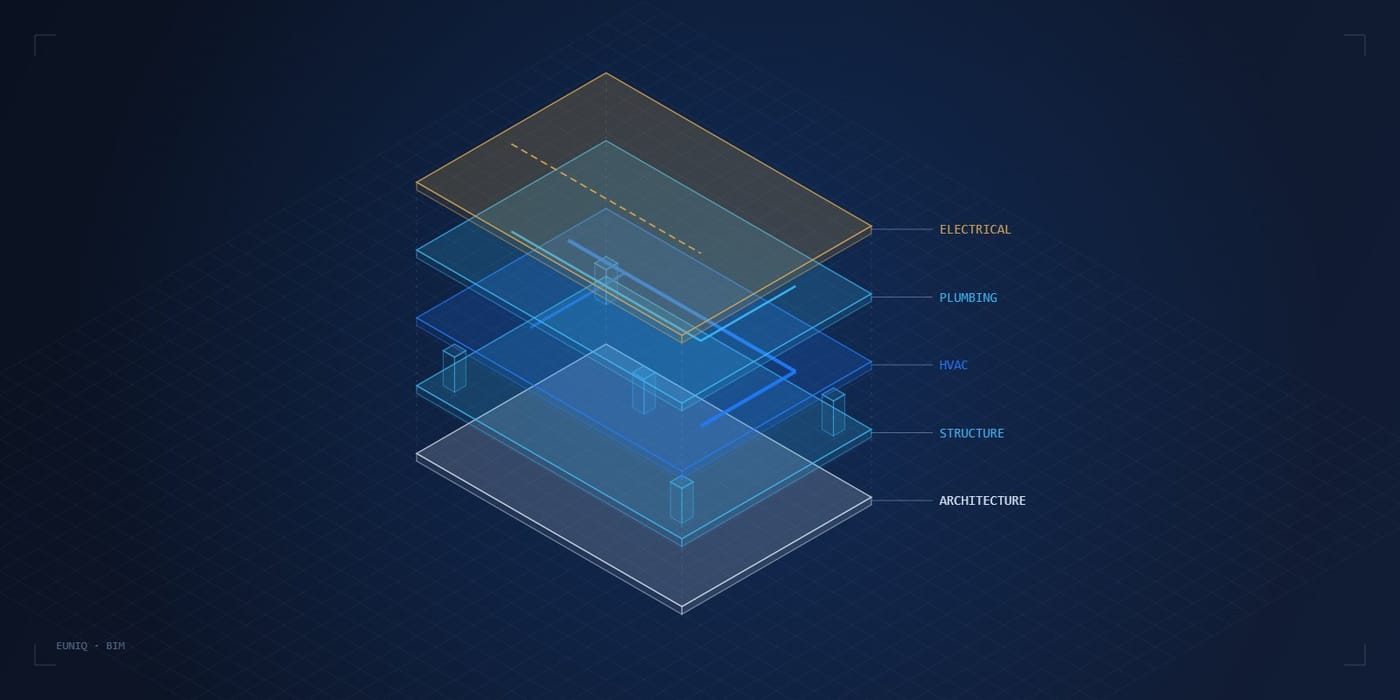
2D coordination, on overlaid drawings, is often set against 3D coordination, on a federated model. In practice most projects mix both. The useful question is not which one to pick, but what each brings and when.
2D coordination
It relies on overlaying each trade’s drawings, with sections at critical points. It remains effective in less dense areas, on projects where not every trade produces a model, and for builder’s work drawings issued to the frame contractor. Its limit: conflicts within ceiling void depth are hard to see without multiplying sections.
3D coordination
It works on the federated model. It reveals conflicts in height, allows systematic clash detection and makes meetings easier to follow. Its limit: it depends on the quality of the models received. An incomplete model gives a false sense of security.
How they complement each other
- 3D to detect, understand and decide in dense areas.
- 2D to formalise: dimensioned coordinated drawings and sections, builder’s work drawings, contract documents.
- Systematic sections to confirm what the 3D suggests.
What really matters: method
Whether in 2D or 3D, successful coordination follows the same logic: collect and check the designs, compare, agree with the trades, approve and follow through to installation. The medium changes; the method does not.
We run MEP and all-trades coordination and architectural coordination in 2D, 3D or a mix, depending on the project.