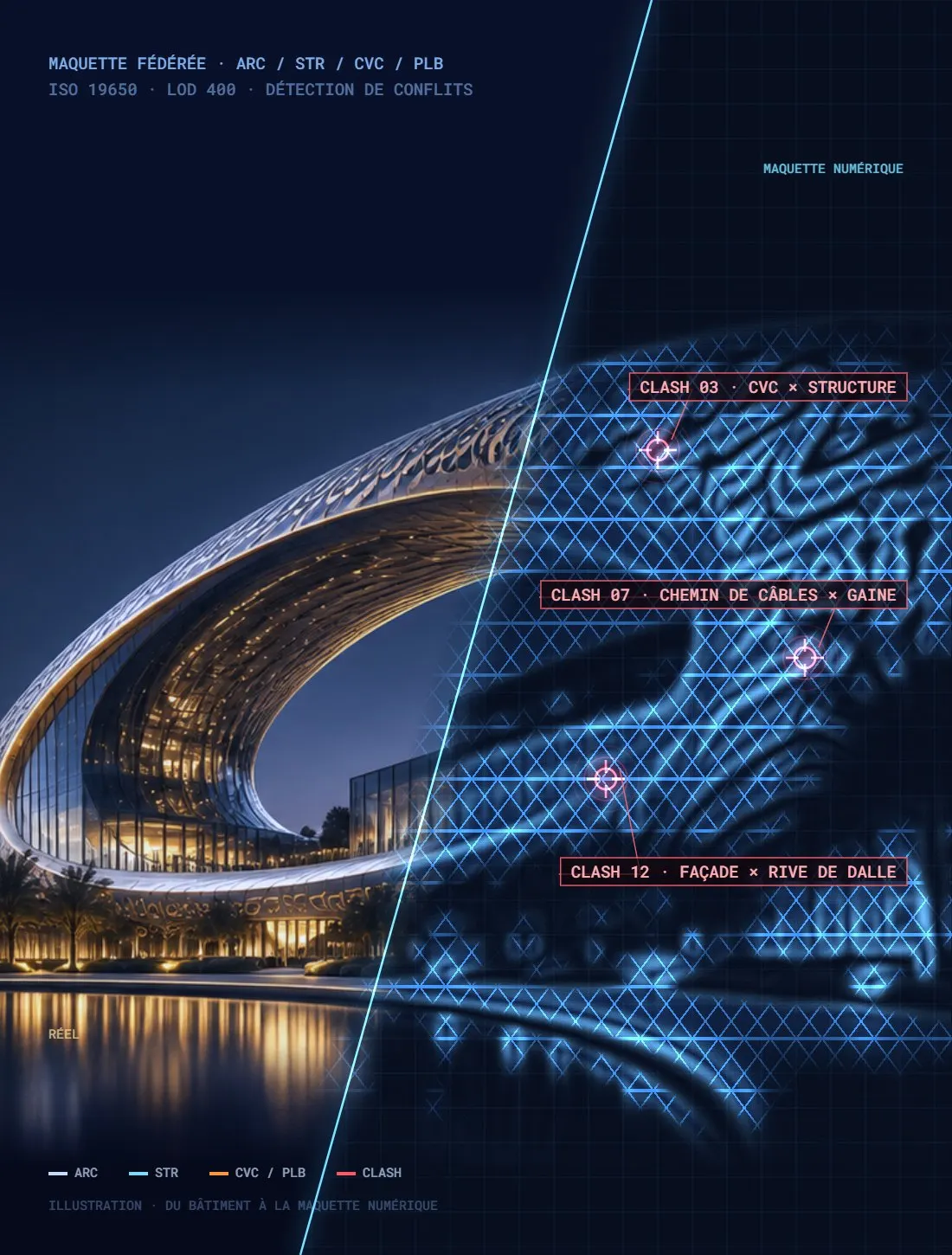
Model federation
Each trade’s model assembled in a shared coordinate system, with origins and levels checked.


EUNIQ CONSULTING · BIM COORDINATION
Model federation, clash detection, grouping by cause, BCF tracking and verification of fixes: we turn clash detection into a decision tool, not a report of thousands of lines.
Software produces thousands of clashes in minutes. Our work starts there: configure the tests, group, prioritise, get decisions made and verify them.
Each trade’s model assembled in a shared coordinate system, with origins and levels checked.
Model checks before clash runs: classification, properties, duplicates.
Trade-against-trade matrices, differentiated tolerances, justified exclusions.
Grouping by cause, separating blockers from adjustments, structure and openings first.
Each issue assigned, dated and tracked from one revision to the next, whatever the trade’s software.
Short, prepared reviews focused on the decisions needed.
The BIM coordination workflow follows the upload rhythm. Each cycle ends with fixes checked on the next revision.
RECEIVE
Models uploaded to the CDE on the agreed schedule.
CHECK
Origin, levels, classification and standards compliance.
DETECT
Configured clash tests, grouping by cause, prioritisation.
DECIDE
Meeting, agreed solution, owner and deadline, then verification on the next revision.
A checked assembly, up to date with the latest approved revision.
A few dozen grouped and ranked issues, not thousands of lines.
Issues located, assigned and tracked.
Non-conformities by model, with the fixes required.
Decisions taken in coordination meetings.
Open issues over time, by trade and by zone.
OUR RESPONSE
Tests and tolerances reviewed, grouping by cause, a report reduced to the issues needing a decision.
OUR RESPONSE
Systematic checks on the next revision, status updated in the register.
OUR RESPONSE
Origins, levels and units checked before any clash run.
OUR RESPONSE
BCF readable in every tool, and priority issues reviewed in the meeting.
Meetings deal with qualified issues, not lists.
Blockers are resolved before pre-construction.
Checked at every revision, they also serve quantities and operation.
Every issue has a history, a decision and an owner.
Main contractors and design teams on offices, industrial plants and data centres who need a multi-trade coordination process that holds.
Navisworks for federation and clash detection, Solibri for rule-based checking, Revit for modelling and BCF for issues. We adapt to the project’s CDE.
Usually at every model upload, often every one to two weeks at construction stage.
No. It prepares and secures it. Technical coordination then settles routing and produces the reference drawings.
Yes. IFC lets trades using different software coordinate together.
Send us your input data: drawings or models, brief, programme, BIM requirements. We come back to you with a proposal matched to your project stage and organisation.
CALL BACK WITHIN 24 H
An engineer contacts you to clarify scope, trades involved, timescales and deliverables.
PROPOSAL WITHIN 48 H
A commercial proposal can be sent within 48 hours of receiving your input data.