


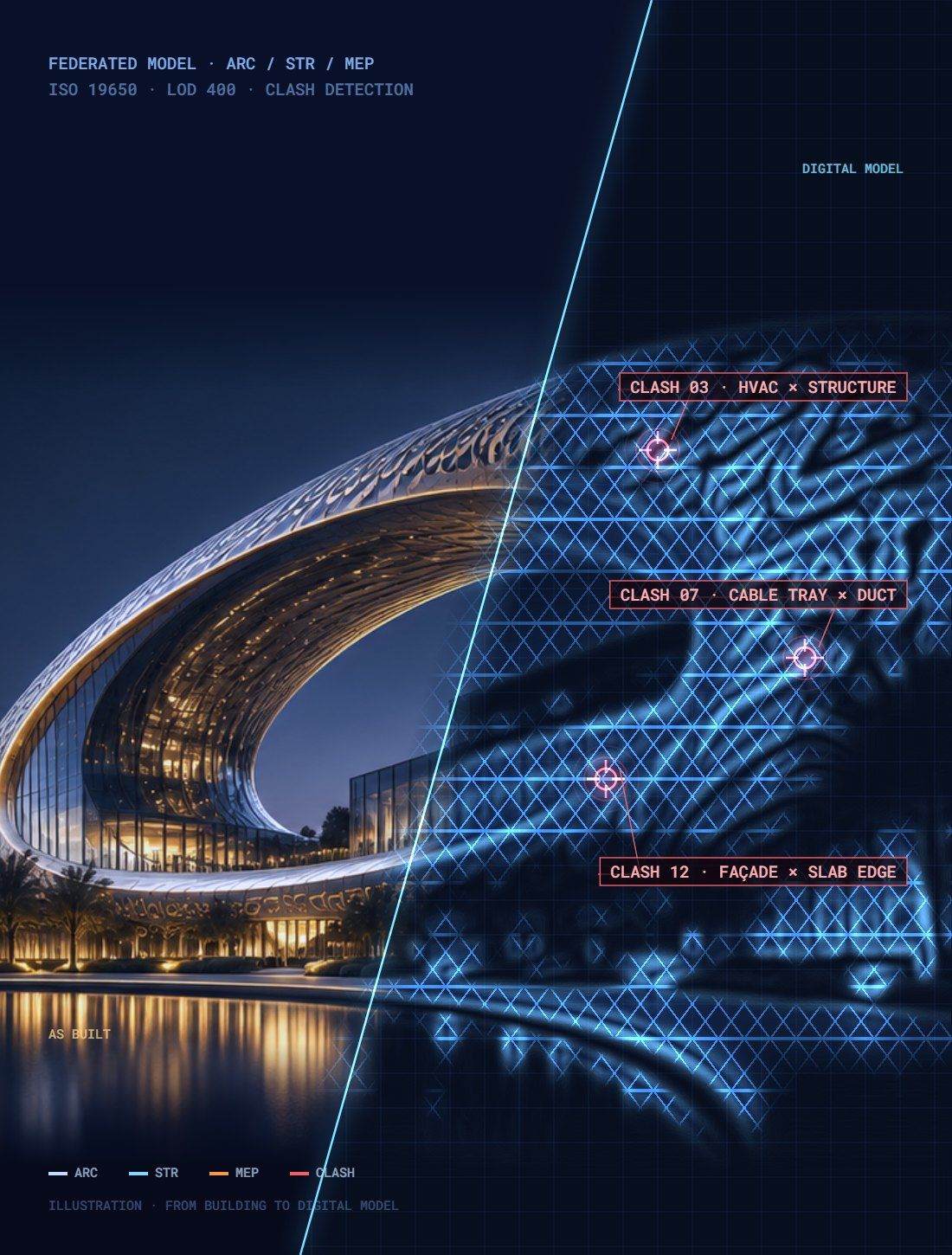
At construction stage, clash detection is usually the first BIM tool people point to. It is also the one that disappoints most when poorly run: reports thousands of lines long, meetings going round in circles, and clashes reappearing during installation. Here is how we run it so it genuinely serves the site.
Before detecting: check the models
Clash detection on misaligned models produces nothing but noise. Before any run we check each model’s origin and orientation, levels, units, object classification and revision. A trade model that is not on its latest revision skews the whole cycle.
Set up useful clash tests
Running “everything against everything” is the surest way to bury the real issues. Instead, build a trade-against-trade matrix with tolerances suited to each pair:
- hard clashes between structure and services, with no tolerance;
- insulation clearances around insulated ducts and pipes;
- installation and maintenance zones in front of plant that must be operated;
- justified, documented exclusions, such as sleeves already allowed for in builder’s work.
Qualify rather than count
The number of clashes is not an indicator. A hundred collisions may come from one service run set too low. Group by cause, separate blockers (structure, openings, clear height) from minor adjustments, and deal first with what affects pours and procurement. A useful report comes down to a few dozen qualified issues.
Get decisions made in the meeting
A coordination meeting is not a model walkthrough. Each issue arrives prepared: a view, the cause, one or two options, the trade concerned. You leave with a decision, an owner and a deadline, tracked in BCF so each trade finds the issue in its own software.
Verify on the next revision
An unverified fix is not a fix. At every new upload we check that closed issues really are closed and that the solution has not created a new clash elsewhere. The register keeps the history: who decided what, and when.
Clash detection is a tool. What protects the site is the method around it: prepare, qualify, decide, verify. It is at the heart of our BIM coordination and MEP coordination services.